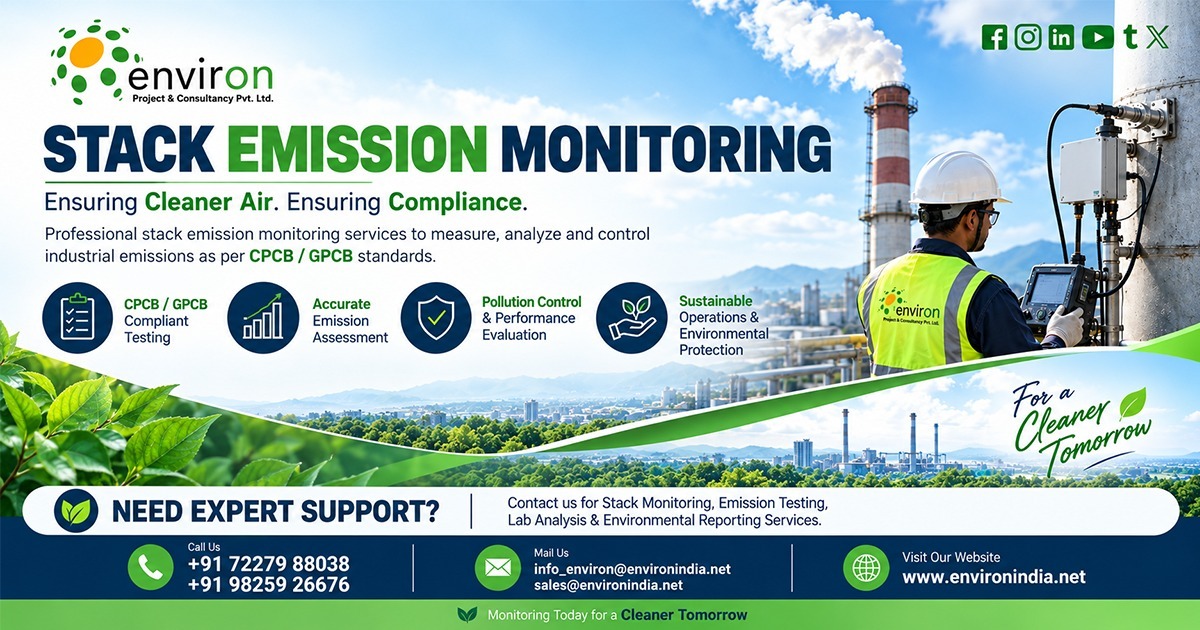

Quick Answer (AEO Snippet): Stack emission testing is the process of collecting and analysing exhaust gases from industrial chimneys to measure pollutants such as PM, SO₂, NOₓ, CO, VOCs and heavy metals, and to confirm compliance with CPCB and SPCB limits. It involves site assessment, port selection, isokinetic sampling, laboratory analysis and report generation.
What Is Stack Emission Testing?
Stack emission testing (also called stack monitoring or stack sampling) is a systematic method of measuring pollutants released through industrial stacks and chimneys. It is a core part of air pollution control in manufacturing units.
Objectives:
- Identify the type and concentration of pollutants emitted.
- Verify compliance with CPCB, SPCB and international standards.
- Detect inefficient combustion or faulty pollution control equipment.
- Maintain documented records for regulatory submissions.
Common pollutants measured:
- Particulate Matter (PM)
- Sulphur Dioxide (SO₂)
- Nitrogen Oxides (NOₓ)
- Carbon Monoxide (CO)
- Hydrocarbons and Volatile Organic Compounds (VOCs)
- Heavy metals such as lead and mercury
Why Stack Emission Testing Matters for Manufacturing Plants
- Legal compliance: Under the Environment Protection Act, 1986 and the rules framed under it, CPCB and SPCBs prescribe emission limits. Non-compliance can bring penalties, closure notices or cancellation of consent to operate.
- Worker and community health: Unmonitored emissions are linked to respiratory and cardiovascular illness and cancer. Industrial clusters such as Ludhiana and Ankleshwar have seen regulatory action over toxic emissions.
- Environmental responsibility: Industrial stacks contribute to air pollution, acid rain and climate change. Regular monitoring reduces your environmental footprint.
- Operational efficiency: High emissions often signal poor combustion or equipment faults. Early detection saves fuel and reduces maintenance costs.
- Corporate reputation: Verified compliance strengthens ESG reporting and stakeholder trust.
Which Industries Need Stack Emission Testing?
- Thermal power plants and boilers
- Cement and steel manufacturing units
- Chemical and petrochemical plants
- Pharmaceutical facilities
- Textile and dyeing units
- Foundries and forging units
- Food processing and packaging plants
- Waste incineration facilities
Rule of thumb: If your facility burns fuel, runs furnaces, dryers or DG sets, or generates combustion gases, regular stack monitoring is required.
Step-by-Step Process of Stack Emission Testing
1: Pre-Testing Site Assessment and Planning
- Survey the number of stacks, dimensions, access platforms and operating conditions.
- Review previous test reports and consent conditions.
- Finalise the pollutant list based on industry type and applicable standards.
2: Selection of Sampling Ports and Traverse Points
- Locate ports at least 8 stack diameters downstream and 2 diameters upstream of any bend or obstruction (as per IS and EPA guidelines).
- Determine traverse points by stack diameter, using the Equal Area or Log-Chebyshev method.
3: Equipment Setup
- Sampling probe (stainless steel or borosilicate glass).
- Filter assembly for particulate capture.
- Impingers with absorbing solutions for gaseous pollutants.
- Vacuum pump with flow control and a dry gas meter.
- Thermocouples and pressure gauges for real-time monitoring.
- CEMS for continuous monitoring where required.
4: Isokinetic Sampling
- Collect the sample at the same velocity as the gas flowing in the stack.
- Incorrect sampling velocity gives unrepresentative particulate results.
- Each run typically lasts about 60 minutes, with a minimum of three runs for reliability.
5: Sample Collection, Preservation and Chain of Custody
- Seal, label and preserve samples as per standard protocol.
- Maintain chain-of-custody records from site to laboratory.
6: Laboratory Analysis
- Gravimetric analysis for particulate matter.
- Spectrophotometry for SO₂ and NOₓ
- Gas chromatography for VOCs and hydrocarbons.
- Atomic Absorption Spectroscopy (AAS) for heavy metals.
- Quality control checks to ensure accuracy and traceability.
7: Reporting and Compliance Review
- Emission concentrations for each pollutant.
- Comparison with CPCB, EPA 1986 and IS limits.
- Stack flow rate, temperature, moisture and velocity data.
- Observations and corrective-action recommendations.
- Submission to the regulator and retention for audit records.
Standards and Regulations in India
- Environment (Protection) Act, 1986: Primary legislation for air quality and emissions.
- CPCB General Standards: Permissible limits for industrial pollutants.
- IS 11255 series: Methods for stack emission measurement.
- IS 5182 series: Methods for measuring air pollution, including stack gases.
- NABL accreditation (ISO/IEC 17025): Ensures legally valid, reliable test reports.
How to Choose a Stack Emission Testing Company
- NABL and MoEF&CC recognition: Confirm valid accreditation and scope.
- Sector experience: Proven work in your industry.
- Modern equipment: Calibrated isokinetic samplers and analysers.
- Timely reporting: Reports aligned to consent and regulatory deadlines.
- Pan-India field presence: Consistent service across multiple plants.
- Single-window solutions: Ambient air, workplace monitoring, water, wastewater, soil and noise testing along with stack monitoring.
Why Choose Environ Projects and Consultancy Pvt. Ltd.?
- Standards-based stack monitoring aligned with CPCB, SPCB and IS methods.
- Experienced field teams and trained sampling engineers.
- Accurate, audit-ready reports with clear compliance interpretation.
- Practical recommendations to improve combustion efficiency and control-system performance.
- End-to-end environmental compliance support under one roof.
Frequently Asked Questions
Q1: How often should stack emission testing be done?
A1: Frequency depends on your consent conditions and industry category. Many plants test monthly or quarterly, while CEMS provides continuous data.
Q2: What is isokinetic sampling?
A2: It is sampling gas at the same velocity as the stack flow, ensuring the collected particulate matter truly represents actual emissions.
Q3: Which pollutants are tested in stack monitoring?
A3: PM, SO₂, NOₓ, CO, hydrocarbons, VOCs and heavy metals such as lead and mercury, depending on the process.
Q4: Is NABL accreditation mandatory for stack testing labs?
A4: Regulators generally expect testing from accredited or recognised laboratories, as NABL-backed reports are more reliable and legally defensible.
Q5: What happens if my plant exceeds emission limits?
A5: You may face penalties, show-cause notices, closure directions or consent withdrawal, so corrective action should begin immediately.
We Offer Stack Emission Testing Service Provider in Gujarat including locations Ahmedabad, Surat, Vadodara, Rajkot, Bhavnagar, Jamnagar, Anand, Gandhinagar, Bharuch, Morbi, Vapi, Valsad, Junagadh, Nadiad, Mehsana, Porbandar, Godhra, Navsari, Surendranagar, Patan, Amreli, Palanpur, Modasa, Dahod, Gandhidham, Bhuj, Ankleshwar, Kalol, Sanand, Halol, Kadi, Khambhat, Jetpur, Kutch, Mundra, Morbi, Rajpipla, Dwarka, Dholka, Gandharpur, Bhachau, Chotila, Dhandhuka, Umargam, Padra, Jhagadia, Kalol, Savli, Sachin, Palghar, Godhra, Vallabh Vidyanagar, Mandvi, Halvad, Balasinor, Nandesari, Pardi, Karamsad.
Book accurate, NABL-aligned stack emission testing with Environ Projects and Consultancy Pvt. Ltd. and stay compliance-ready today.
Website: www.environindia.net
Email: info_environ@environindia.net | sales@environindia.net
Phone: +91 72279 88038 | +91 98259 26676
View Product: Click here