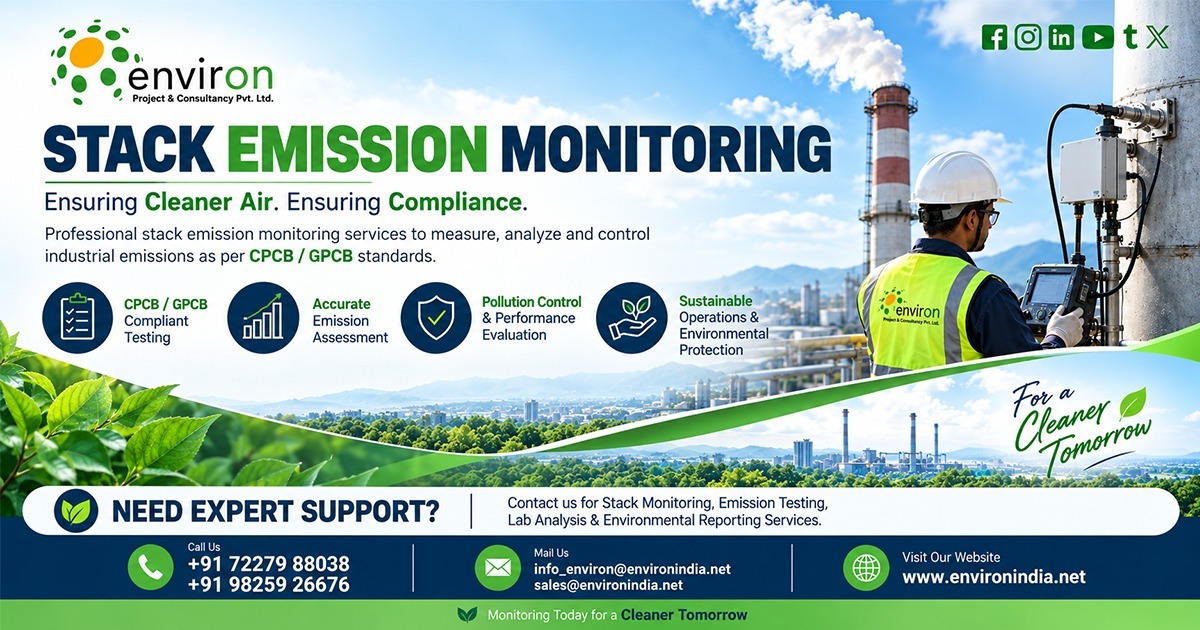

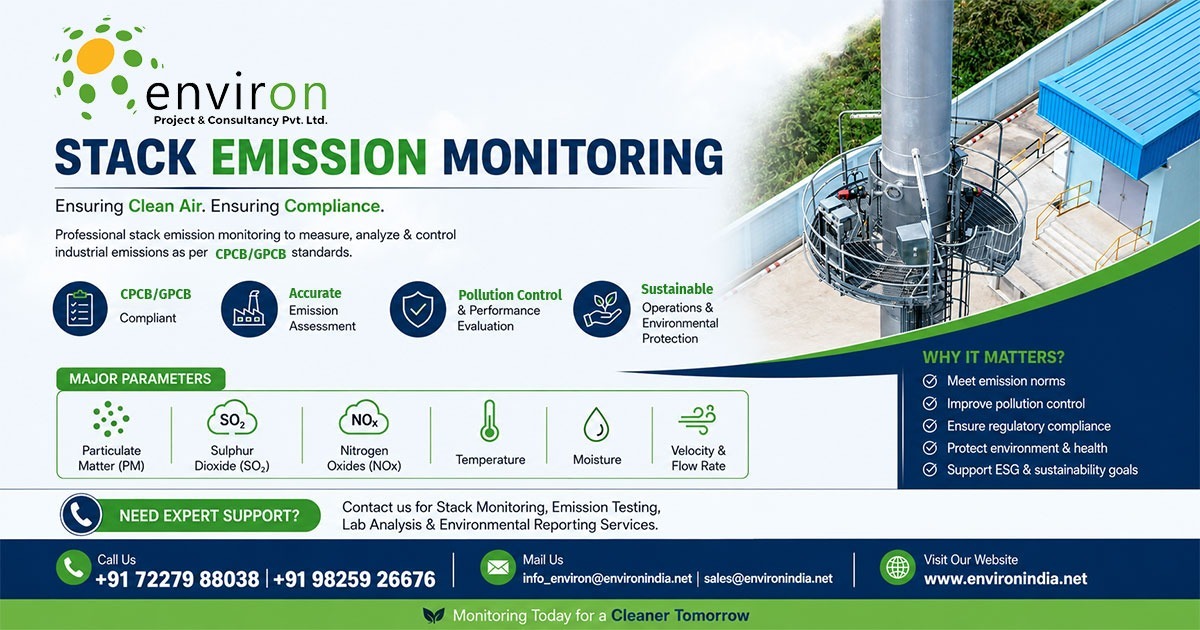
Environ Projects and Consultancy Pvt. Ltd. provides comprehensive stack emission monitoring and testing services to help industries assess air pollutants released through chimneys, exhaust stacks, boilers, furnaces, generators, and other industrial sources.
Stack emission testing measures pollutant concentrations and operating conditions to evaluate compliance with applicable environmental standards and identify opportunities to improve air pollution control.
Our services support industrial facilities across India with:
- Industrial stack emission monitoring and analysis.
- Boiler, furnace, kiln, and chimney emission testing.
- Diesel generator exhaust monitoring.
- Particulate matter and gaseous pollutant assessment.
- Air pollution control equipment performance evaluation.
- CPCB and SPCB compliance documentation.
- Environmental audit and consent-related reporting.
- Emission reduction and corrective-action planning.
Environ Projects and Consultancy Pvt. Ltd. helps industries convert emission data into practical environmental compliance and operational improvement strategies.
Importance of Stack Monitoring
Regular industrial stack monitoring helps businesses understand what their facilities release into the atmosphere and whether existing pollution control systems operate effectively.
Stack Emission Standards and Regulations
Industrial stack emissions in India are regulated through applicable environmental legislation, notified emission standards, regulatory directions, and facility-specific consent conditions.
The relevant framework may include:
- The Environment (Protection) Act, 1986.
- The Environment (Protection) Rules, 1986.
- The Air (Prevention and Control of Pollution) Act, 1981.
- Industry-specific emission standards notified by the Government of India.
- Central Pollution Control Board guidance and applicable technical protocols.
- State Pollution Control Board or Pollution Control Committee requirements.
- Consent to Establish and Consent to Operate conditions.
- Environmental clearance conditions, where applicable.
- Continuous emission monitoring requirements for designated industries or installations.
- Stack height, sampling access, and air pollution control system requirements applicable to the relevant facility.
Emission limits differ according to the industry, equipment, fuel, capacity, process, pollutant, and applicable notification.
Compliance should therefore be assessed against the specific standards and consent conditions governing each emission source.
CPCB and SPCB Emission Standards
The Central Pollution Control Board, or CPCB, publishes and references industry-specific environmental standards, while State Pollution Control Boards, or SPCBs, and Pollution Control Committees oversee implementation and compliance within their respective jurisdictions.
Compliance Considerations
- Identify the emission standards applicable to the specific industrial activity.
- Review current Consent to Operate conditions for each stack and process.
- Determine the pollutants requiring measurement.
- Follow the monitoring frequency specified by the relevant authority or consent.
- Provide compliant sampling ports, platforms, and safe stack access.
- Maintain appropriate air pollution control equipment.
- Apply prescribed sampling and analytical methodologies.
- Report results in the required units and reference conditions.
- Maintain monitoring records and supporting operational information.
- Install and maintain continuous emission monitoring systems where specifically required.
- Transmit online monitoring data to regulatory authorities when mandated.
- Implement corrective measures when emissions exceed applicable limits.
Major Parameters Covered in Stack Monitoring
The parameters selected for industrial chimney emission testing depend on the facility’s process, fuel, equipment, and applicable regulatory requirements.
Particulate Emissions
- Particulate matter: Measures dust and solid particles released through the stack.
- Total suspended particulate emissions: Assesses the overall particulate concentration in exhaust gases.
- Smoke and visible emissions: Provides an indication of combustion quality and control-system performance where relevant.
- Opacity: May be assessed when applicable to the source, monitoring system, or regulatory requirement.
Gaseous Pollutants
- Sulphur dioxide, SO₂: Commonly associated with sulphur-containing fuels and industrial processes.
- Oxides of nitrogen, NOₓ: Generated during combustion and certain manufacturing operations.
- Carbon monoxide, CO: Can indicate incomplete combustion or process-related emissions.
- Carbon dioxide, CO₂: Supports combustion analysis and broader emissions assessments.
- Oxygen, O₂: Helps evaluate excess air, combustion efficiency, and emissions normalization.
- Volatile organic compounds, VOCs: Relevant to facilities using solvents, coatings, chemicals, or organic feedstocks.
- Ammonia, NH₃: Relevant to certain fertilizer, chemical, and pollution control applications.
- Hydrogen chloride, HCl: May be relevant to incinerators and specific industrial processes.
- Hydrogen fluoride, HF: May be relevant to glass, ceramic, aluminum, and other applicable industries.
- Hydrogen sulphide, H₂S: May be relevant to petroleum, chemical, and process-specific operations.
Applications
- Thermal Power Plants
- Cement Plants
- Chemical Industries
- Pharmaceutical Industries
- Steel and Metal Industries
- Textile Industries
- Food and Beverage Industries
- Paper and Pulp Industries
- Petroleum and Petrochemical Industries
- Fertilizer Plants
- Ceramic and Glass Industries
- Waste Treatment Facilities
- Manufacturing Units
- Diesel Generator Installations
- Commercial and Institutional Facilities
Frequently Asked Questions
Q1: What is stack emission monitoring?
A1: Stack emission monitoring measures pollutants and operating conditions in industrial exhaust gases released through chimneys, ducts, or stacks.
Q2: Why is stack emission testing required?
A2: It helps industries evaluate regulatory compliance, identify pollution sources, assess control equipment, and reduce environmental risks.
Q3: Which pollutants are commonly tested?
A3: Common parameters include particulate matter, sulphur dioxide, nitrogen oxides, carbon monoxide, oxygen, and other process-specific pollutants.
Q4: How often should stack monitoring be conducted?
A4: Monitoring frequency depends on applicable regulations, Consent to Operate conditions, industry classification, and directions from the relevant SPCB or Pollution Control Committee.
Q5: Which industries require stack emission monitoring?
Q5: Facilities operating boilers, furnaces, kilns, incinerators, generators, and other regulated industrial emission sources may require stack monitoring.
Environ Projects and Consultancy Pvt. Ltd. is Service Provider CGWA Licence Activity Service in Gujarat including locations Ahmedabad, Surat, Vadodara, Rajkot, Bhavnagar, Jamnagar, Anand, Gandhinagar, Bharuch, Morbi, Vapi, Valsad, Junagadh, Nadiad, Mehsana, Porbandar, Godhra, Navsari, Surendranagar, Patan, Amreli, Palanpur, Modasa, Dahod, Gandhidham, Bhuj, Ankleshwar, Kalol, Sanand, Halol, Kadi, Khambhat, Jetpur, Kutch, Mundra, Morbi, Rajpipla, Dwarka, Dholka, Gandharpur, Bhachau, Chotila, Dhandhuka, Umargam, Padra, Jhagadia, Kalol, Savli, Sachin, Palghar, Godhra, Vallabh Vidyanagar, Mandvi, Halvad, Balasinor, Nandesari, Pardi, Karamsad.
Contact Environ Projects and Consultancy today for reliable stack emission monitoring, accurate testing, and regulatory compliance support.
Website: Environ Projects and Consultancy Pvt. Ltd.
Email: info_environ@environindia.net | sales@environindia.net
Phone: +91 72279 88038 | +91 98259 26676